CASE STUDY: Ithra Project – Leveraging 3D Printing for Custom Concrete Walls
Updated: Mar 26
November 2025
Prepared by:
Hussam Salah, Operations Manager, Senior Project Engineer, TamVinci.

Client: Ithra
Location: Dhahran, Saudi Arabia
Units: 140 unique wall panels
Printed volume: 65 m³
Timeline: 70 days
Fabrication duration: 2 months
Tolerance achieved: ±5 mm
Technology: Tilikum 3
Software: Rhino + Grasshopper
Material: custom concrete mix with Sika 752
Award: 2024 iF Design Award – Interior Architecture
Project Overview
As part of the award-winning Net Zero exhibition hosted by Ithra (King Abdulaziz Center for World Culture), TamVinci (a 3DVInci Creations Company) was tasked with the production and installation of approximately 140 uniquely shaped 3D Concrete Printed walls within an exceptionally tight timeline of 70 days, including on-site assembly. The total printed volume reached 65 cubic meters.
Exhibition Context
Ithra’s Net Zero exhibition aimed to showcase sustainable, circular, and innovative approaches to architectural and interior design. The 3D printed concrete walls were not only structural and aesthetic elements but also embodied the exhibition’s ethos of zero-waste, reusability, and low-impact construction.

Project Facts
Client: Ithra (King Abdulaziz Center for World Culture)
Design & Curatorial Lead: ACCIONA Cultura
3D Printing Production & Installation: TamVinci
Location: Dhahran, Saudi Arabia
Fabrication Duration: 2 months (printing)
Number of Wall Units: 140 (all unique)
Total Execution Timeline: 70 days (including installation)
Printed Volume: 65 cubic meters
Awards: 2024 iF Design Award – Interior Architecture
Project Challenges
Extreme Customization: Each wall panel had a distinct geometry and curvature, making traditional precast mold creation time-consuming, expensive, and wasteful.
Aggressive Schedule: The entire process, from digital modeling to on-site installation, had to be completed in 70 days, requiring parallel workflows and meticulous coordination.
Logistical Complexity: The walls were printed off-site and transported to Dhahran. This required precision planning for transport size constraints, weight limits, and sequencing to enable safe, efficient delivery and assembly.
Installation Alignment: On-site tolerances were tight, requiring wall dimensions and interfaces to be extremely accurate to match floor conditions and adjoining components.

Technical Approach
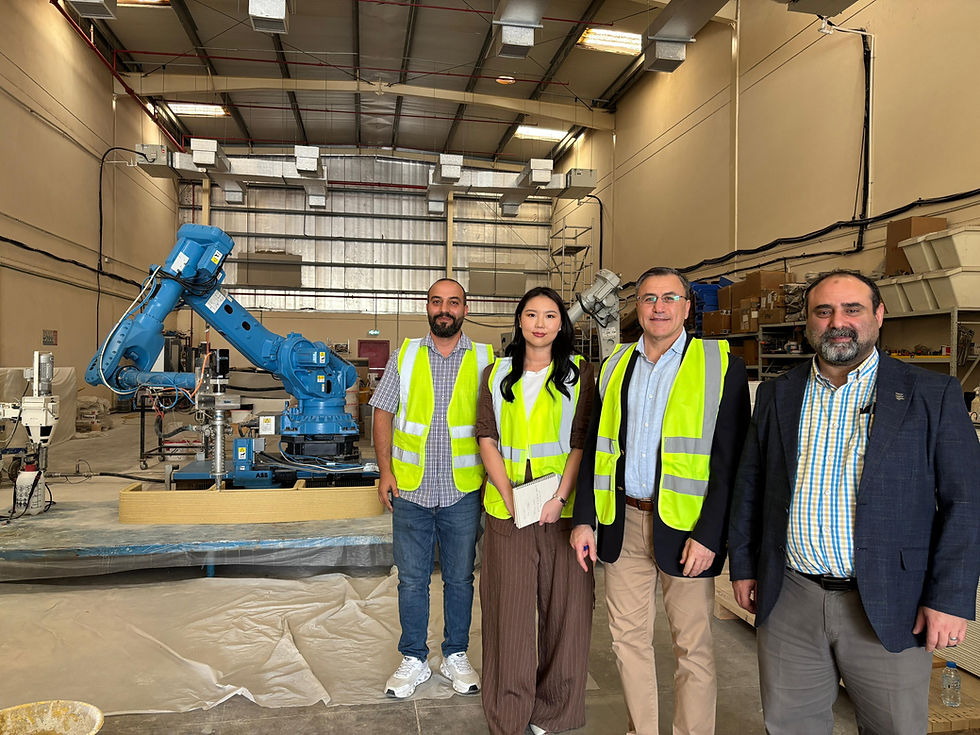
3D Printing Technology: Tilikum 3
Software/Workflow: Rhino + Grasshopper, proprietary slicing tool
Material: Custom concrete mix, engineered for high printability, surface smoothness, and dry-climate durability.
Sika 752 (40-50 MPa)]
Layer Specs: 30 mm layer height, 10 mm nozzle
Tolerances Achieved: ±5 mm
3D Printing Advantages
Eliminated Mold Waste: Designs were printed directly from digital files with no physical formwork required.
Accelerated Production: Enabled rapid fabrication of 140 walls in under 8 weeks.
Design Versatility: Permitted highly organic, undulating forms impossible with traditional methods.
Reusability Focus: Walls were engineered for disassembly and potential reinstallation at future exhibitions, reducing long-term material waste. The Walls are still displayed in the museum
Precision Planning for Transport: Printing parameters were adjusted to balance weight optimization with structural stability, ensuring logistics and installation efficiency.

Results & Metrics
Timeline Achieved: Project delivered within the 70-day deadline
Waste Reduction: Zero Waste
Labor Reduction: 30 % reduction in on-site labor
CO2 Savings: No official value but a significant amount was saved.
Transport Efficiency: Each truck held 10 Walls during transportation
Transport Safety: All walls were secured with latching belts while being transported
Collaboration & Coordination
Close collaboration with ACCIONA Cultura to preserve curatorial vision.
Integrated design review process with Ithra to ensure walls met performance and aesthetic goals.
Design software used: AutoCAD + RHINO
5 team members were involved in production workflow

Lessons Learned & Conclusion
Material moisture calibration and temperature control were essential to ensure layer adhesion consistency during off-site printing.
Early coordination with logistics partners reduced installation risks and kept the tight schedule on track.
Modular digital fabrication significantly increased agility without compromising quality.
The Ithra Net Zero Exhibition is a proof-of-concept for architectural-scale 3D printing in cultural and exhibition design. With over 140 complex wall units delivered on time, waste-free, and reusable, the project demonstrates how additive construction can unlock aesthetic freedom while meeting real-world performance demands.
TamVinci is proud to have contributed to a landmark achievement that pushes the limits of circular design, digital fabrication, and cross-disciplinary collaboration in the built environment.